
Curry County Civil Docket Searches
Start with New Mexico Case Lookup. That is the public route into a Curry County civil docket. The court's own example shows how the fields fit together. It uses Type Court D, a court location, the CV category, and a year. The case number completes it. Those fields keep a District Court civil case from mixing with other records. A Magistrate, Probate, or municipal record stays separate. A Curry County District search, a Curry County Magistrate search, and a Curry County Probate search are separate. A Curry County municipal search is separate too. That is four separate queries. Keep the location and category the court assigns rather than guessing keywords.
Use the exact court-assigned number whenever you have it. There is no full public dictionary of local CV numbers. A party-name result may not cover everything. Registered re:SearchNM access offers more functions to eligible users. A dead end means the court or clerk channel should be checked, not that no Curry County civil case exists. The key details are simple. For any Curry County docket search, they are the court location, the case category, the year, and the case number.
- Open New Mexico Case Lookup and select the correct court type and Curry County location.
- Use the civil CV category with the year and case number when those details are known.
- Confirm the case style, court location, filed date, and displayed case type before relying on a result.
- Read the register entries and current setting, noting whether a document is displayed or only described.
- Contact the court clerk for inspection or a copy when the docket does not provide the particular record needed.
Note: The public civil search covers electronic case information. It does not promise that every Curry County filing appears online.
Curry County CV Docket Fields
New Mexico's own materials split access into two layers. The public Case Lookup layer is the first. The New Mexico Courts public-access instructions walk through the civil example using the court, location, category, year, and case number fields. That sequence works best when you hold a Curry County civil docket number but no party name.
The second layer is registered re:SearchNM access for eligible users. It can open Case Details and Related Cases views. Documented fields include the case style, location, type, filed date, case number, related case, and related reason. Registration does not override redaction, sealing, or document limits. It also cannot replace a request to the Curry County clerk. Certified or paper records still go through that request. Public Curry County results and registered results each follow an access path. Paper files and certified copies follow different paths.
| Official field | Use in a Curry County civil search | Format or limitation |
|---|---|---|
| Type Court | Choose the court level before searching | The civil instructional example uses D |
| Court Location | Route the query to the appropriate Curry County court site | Do not assume courts share one case file |
| Case Category | Limit the query to civil records | The official example uses CV |
| Year and Case Number | Identify a specific docket | Use the number exactly as issued |
Civil Dockets: What They Show
Think of a Curry County civil docket as a register, not a story. It records what was filed and when. Typical entries include a complaint or petition, service and return, an answer, and motions. Scheduling and pretrial events follow. So do discovery activity and mediation or settlement events. Orders, judgment, an appeal, and costs or fees also appear. Each Curry County case is different. What it shows must be read from its own register of actions.
The header usually carries the case number, case style, location, type, filed date, and status. An entry can say an order or judgment was filed without attaching it. The Case Access Policy ties online documents to redaction and digitization. Read each public entry for its date and official title first. Then make a narrow clerk request if you need the document itself. Filing entries, order entries, judgment entries, and hearing entries are not the same. Each one has its own purpose. The differences matter in Curry County court records.
| Case details | Case number, case style, location, type, filed date, and displayed status. |
|---|---|
| Pleading entries | Complaint or petition, answer, motion, order, and other titled filings when entered. |
| Service activity | Service or return information when it appears in the register. |
| Settings | Scheduling, pretrial, motion, status, or other hearing date and direction. |
| Outcome entries | Judgment, dismissal, order, appeal, mediation-related event, or another listed disposition. |
Curry County Civil Court Boundaries
Know the court before you search. The state court finder places District Court civil matters over $10,000. It also takes tort, contract, real-property, estate, domestic-relations, mental-health, and miscellaneous civil cases. Lower-court or agency appeals land there too. Magistrate Court holds a separate civil range for listed tort and contract matters from $0 to $10,000, per the Ninth Judicial District overview.
That $10,000 line shows where the court system files these record types. It is not filing advice. A Magistrate Court civil docket in Curry County sits with that court's clerk. The Curry County District Court Clerk's Office keeps the District Court civil docket. The Curry County Clerk is a county-records official and does not hold these case files. District files, Magistrate files, Probate files, and county administrative records in Curry County are kept apart. Each type has its own custodian.
| Court channel | Civil docket scope in the research | Custodian route |
|---|---|---|
| Curry County District Court | Civil matters over $10,000, domestic matters, estates, tort, contract, real property, and appeals | District Court Clerk's Office |
| Curry County Magistrate Court | Listed tort and contract matters from $0 to $10,000 | Magistrate Court Clerk's Office |
| Curry County Probate Court | Informal probate and uncontested estates | Probate Court clerk/contact |
What Cases Fill the Civil Docket
Which court holds a Curry County civil docket depends on two things. One is the type of matter. The other is the path it takes. District Court lists civil work covering tort, contract, real-property, estate, domestic-relations, mental-health, and miscellaneous civil cases. Appeals are included too. Magistrate civil jurisdiction is narrower. Probate runs on its own channel for informal probate and uncontested estates. Think of a category as a lead toward the right file. It will not predict the facts or documents inside any single Curry County case record. Match the civil category, the court channel, the clerk route, and the case number first. Do that before assuming where a filing lives. A docket search goes faster once those pieces line up.
- District Court tort, contract, real-property, and other civil matters within its listed jurisdiction.
- District Court domestic-relations work, including divorce and child-support functions identified by the state court finder.
- Magistrate Court tort and contract matters from $0 to $10,000 in the Ninth overview.
- Probate Court informal probate and uncontested-estate records.
- District Court appeals from lower courts or agencies when the matter moves beyond its first forum.
Domestic-violence matters in Curry County have their own intake route through the DVO Clerk at District Court. This is not a routine public case lookup. It is a designated channel for getting help with a filing. The Ninth Judicial District domestic-violence contact listing shows that intake point directly. Use it rather than a general docket search. Anyone needing case access on these matters has one route. Follow the DVO Clerk route at the District Court.
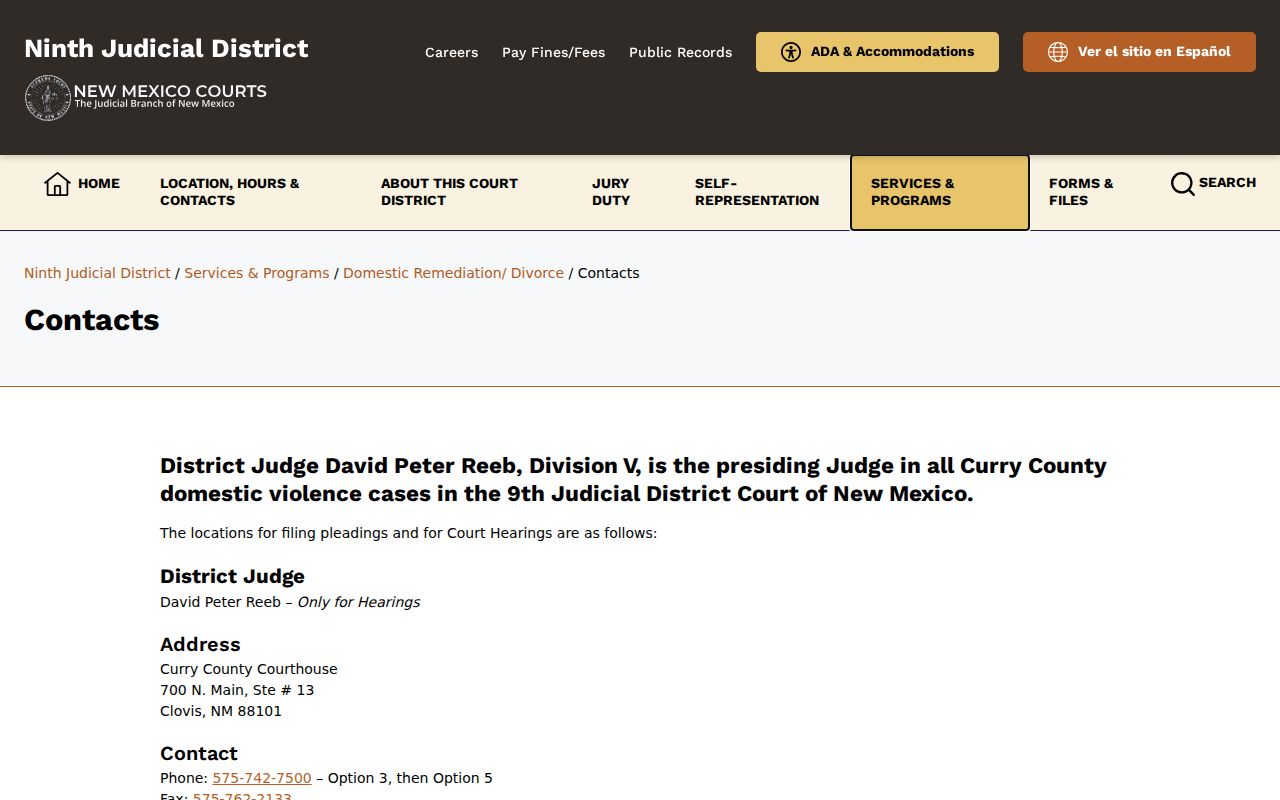
The listing makes one thing plain. Some Curry County civil docket questions must go through the designated court clerk, not a public search.
Curry County Probate Docket Split
Probate shows why court names matter in a Curry County civil search. Curry County Probate Court handles informal probate and uncontested estates. Its published contact is 417 Gidding St., Suite 130, Clovis, NM 88101, at 575-763-5591. When you call, name the record you need. Ask for an item by name. Request an application, an appointment, an inventory, an order, a certificate, or the complete probate file. Do not settle for a general estate record.
A contested probate matter moves to District Court. So a Probate Court query can come up short for a dispute that proceeded there. Do not assume the two courts keep one interchangeable file. Confirm the court history with the clerk. Do this before requesting copies, especially when the docket entry shows only case metadata or an earlier probate event. Probate entries and District Court entries may describe different stages of the same estate.
Note: A contested estate may have a District Court record. Its earlier Curry County probate activity may have begun in Probate Court.
Hearings on the Civil Docket
A Curry County civil docket can list scheduling, pretrial, motion, status, child-support, or other hearing activity. The Ninth Judicial District's remote and hybrid plan lists several categories. Civil scheduling, pretrial, motions, status matters, bond forfeiture, and child support may all be held remotely. The individual notice still controls the setting. A calendar listing is a scheduling tool. It is not a complete civil register, and it cannot guarantee an event stays unchanged.
Read the newest docket entry and the notice together. Confirm the date, time, court location, division, and hearing type, and check whether any remote direction appears. Under the plan, a remote event requires a Google Meet link or QR code in the notice. Without that instruction, plan on an in-person Curry County setting. Verify the details with the court clerk. The current notice governs over everything else.
A continuance, reset, or mediation entry is just a step in the case. It is not a result. If the court shows a new setting, rely on that newest entry instead of an older date. For the broader calendar process, see the Curry County Court Schedule.
Curry County Civil Mediation Entries
A mediation line on a civil docket is a clue, not a public disclosure of a settlement. The 2024 New Mexico Judiciary annual report notes that the Ninth Judicial District completed 30 mediations in its district program for domestic-relations and civil matters in FY2024. Most of those involved unrepresented litigants. That figure describes the district program overall. It does not mean any particular Curry County case went to mediation. Treat the number as context, nothing more.
An entry mentioning mediation, a status conference, or scheduling reveals no confidential communications. It proves no settlement. Rule 1-079 and the Case Access Policy still control redaction and public document access. Need a specific civil record from Curry County? Ask for an order, a judgment, or a register entry by name. Mediation entries and status entries simply do not carry that information. Orders and judgments do.
Who Can See Civil Dockets
Public access to Curry County civil dockets is presumed, but the presumption has limits. New Mexico Rule 1-079 counts many things as court records. Documents, exhibits, transcripts, registers of actions, and docket entries all qualify. It also directs protection of personal identifiers. The rule recognizes both automatic and court-ordered sealing. Redacted online access is not unrestricted access to every document in a case file. Public records, redacted records, sealed records, and clerk requests each carry different limits. Read the rule before requesting a full filing.
Public-access rules:
NMSA 1978, Section 14-2-1 et seq. supplies the New Mexico Inspection of Public Records Act access route for available court records.
Rule 1-079 NMRA governs public court records, protected identifiers, and sealing.
Order 23-8500-007 describes redacted public records and access groups for online court records.
Privacy rules shield most personal identifiers on a Curry County civil docket. Think Social Security numbers, taxpayer IDs, and financial-account numbers. Driver-license details are protected as well. A birth date is likewise covered, with only the year left visible. Sealing takes more than a clerk's say-so. A judge must issue a written, narrowly tailored order. It must state whether the register itself is sealed, who may see it, and for how long. One more caution: a placeholder for a sealed filing tells you nothing about the document's contents. The public may not reach it either. Keep Curry County protected material, sealed material, redacted material, and plain public entries straight as you read the docket.
Curry County Civil File Requests
Does the online Curry County civil docket leave out the attachment you need? Go to the court that actually holds the record. For District Court files, start with the Curry County District Court Clerk's Office. It sits at 700 N. Main St., Suite 11, Clovis, NM 88101, and answers at 575-742-7500. Magistrate, Probate, and municipal files run through their own clerks. A solid Curry County civil request names the court, the case number, the record type, and the date range. Then say whether you want inspection, a plain copy, or a certified copy. Copy requests and certification requests should always name the exact court.
Prefer one statewide form? The New Mexico Courts IPRA form asks for the court location, the responsible court or department, your contact details, and a reasonably particular description of the record. No reason is required. Fees come from the Ninth fee schedule. Photocopies run $0.35 per page. Certification costs $1.50 each, and tape or CD duplication runs $4 each. Payment is due before you receive anything. Don't confuse these charges with civil filing fees. They are separate costs entirely.
The official SB 208 legislative materials lay out New Mexico's public-record request framework, which governs a Curry County civil docket request. The court itself is the place to confirm current response timing and any extension. That three-day copy estimate on the fee page is a local processing estimate only. It is no promise for a complex IPRA request. Timing, fee questions, and delivery arrangements all come down to the clerk.
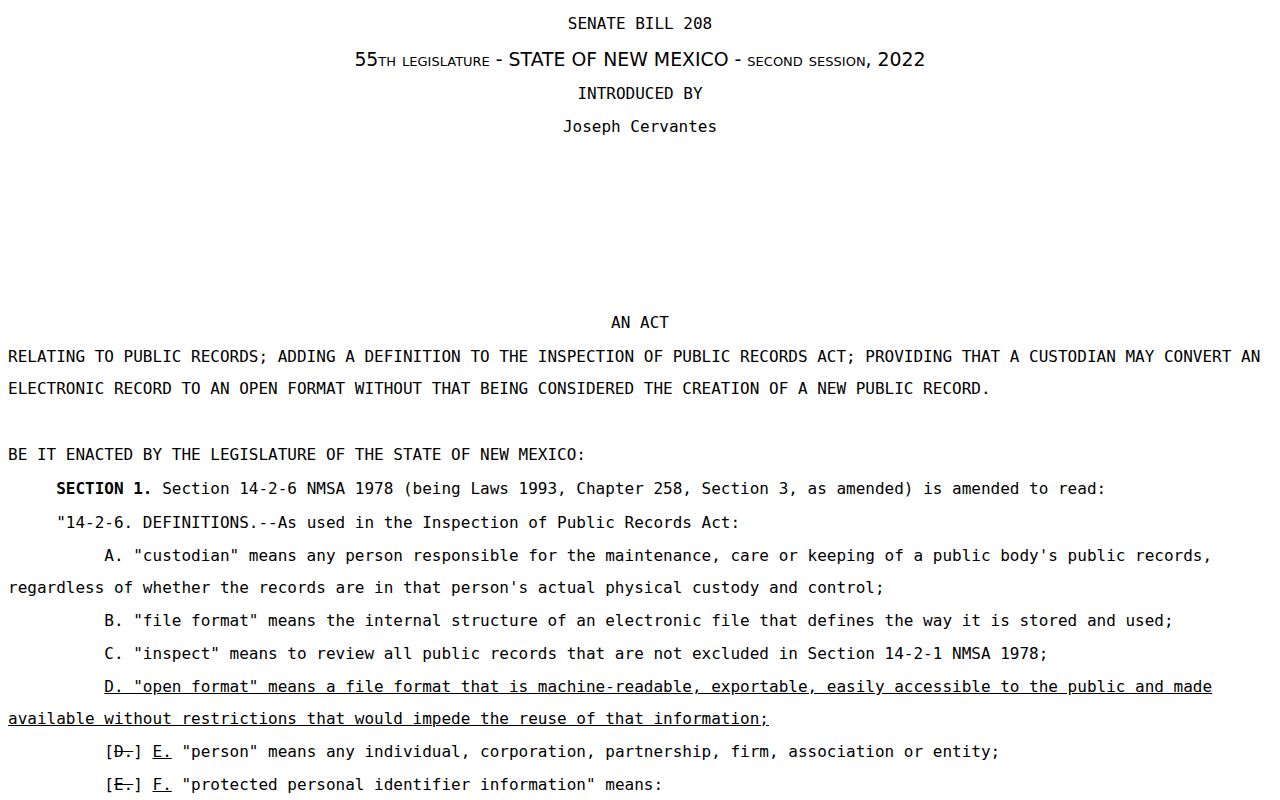
New Mexico's public-record framework is where any Curry County civil docket request sits. For the file itself, the responsible clerk remains the source.